
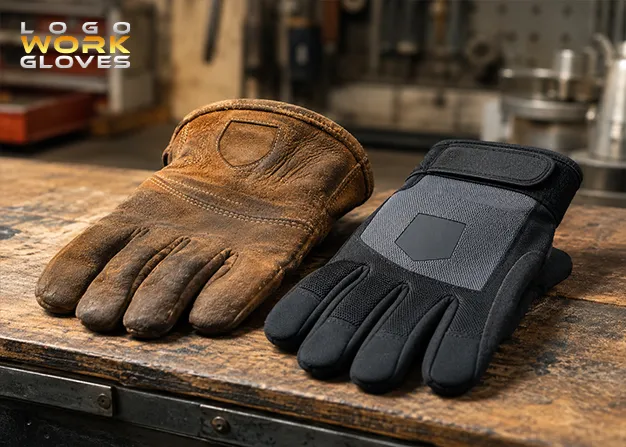
You have the artwork, you have picked your glove, and then the question lands: should your logo be pressed into the leather or printed onto it? Most buyers reach that fork with no clear way to break the tie, so they guess.
Here is the short answer. A Deboss is the right call when you are ordering full-grain leather gloves and your logo is a clean single color mark that needs to survive years of abrasion. A Heat Transfer is the right call when your logo carries multiple colors, fine gradients, or sits on a synthetic or fabric back panel where an impression simply will not hold. At Logo Work Gloves LLC, both methods cost the same, so the choice comes down to material and artwork, not budget.
That last point changes the whole conversation. Once price stops being the tiebreaker, you are free to pick the method that genuinely serves your brand and your crew. This guide walks you through exactly that decision.
Debossing brands your logo into the hide itself because a heated steel branding plate compresses the leather fibers permanently, which means the mark becomes part of the glove rather than a layer sitting on top of it.
The process at our shop is straightforward. We machine a steel branding plate from your artwork, heat it to roughly 500 degrees, and press it into the back of the glove under controlled pressure. The result is a crisp sunken impression that reads clearly without changing the leather’s color or making the hide brittle.
Depth is the variable that separates a good deboss from a mediocre one. Press too shallow and the logo disappears once the leather softens with wear. Press too deep and you risk scorching the grain. Leather deboss depth has to be dialed in against the specific hide, which is why the same plate gets a slightly different setting on goatskin than it does on heavyweight cowhide.
Debossing performs best when:
Where debossing struggles:
In practice, a deboss on a full-grain driver glove is one of the cleanest branded looks available in workwear. The logo catches light at an angle, it never peels, and it ages with the glove instead of against it.
Heat transfer printing applies your logo as a durable printed film bonded to the glove surface under heat and pressure, which means it can reproduce full color artwork that no impression method can match.
We produce the transfer from your file, position it on the back of the glove, and press it so the adhesive layer fuses into the material. The finished mark is flexible, it moves with the glove, and it holds detail that a steel plate would flatten.
The obvious advantage is color. A full color transfer can carry your exact brand palette, gradients, drop shadows, and multi element lockups in one pass. If your identity depends on a specific blue sitting next to a specific orange, a Deboss cannot deliver that and a transfer can.
Heat transfer performs best when:
Where heat transfer struggles:
The honest tradeoff: a deboss cannot fade because there is nothing to fade, while a transfer can eventually show wear on the highest contact areas of a glove that lives a hard life. Against that, a transfer gives you color fidelity a branding plate will never reach.
The two methods solve different problems, so comparing them on a single scale like “which is better” produces a bad answer. Compare them on the variables that actually drive the outcome.
| Factor | Debossed Logo | Heat Transfer Logo |
|---|---|---|
| How it is applied | Steel branding plate heated to 500 degrees, pressed into the hide | Printed film bonded to the surface with heat and pressure |
| Color capability | No color added, single tone impression only | Single color through full color, including gradients |
| Best material | Full-Grain Leather, premium cowhide, elkskin, deerskin | Synthetic leather, spandex and canvas backs, smooth grain leather |
| Detail tolerance | Bold shapes and thick strokes | Fine lines, small type, complex lockups |
| Logo durability | Permanent, cannot peel or fade | Very strong, may show wear at extreme contact points |
| Visual character | Subtle, premium, tonal | Bold, high contrast, immediately readable |
| Effect on the glove | None, the leather stays supple | None, the film flexes with the material |
| Cost at Logo Work Gloves | Same as heat transfer | Same as deboss |
Notice the last row. Because pricing is identical, this table is a pure fit exercise. You are matching a method to a material and an artwork file, nothing else.
Material dictates method more than any other factor because the surface either accepts a compression impression or it does not, and no amount of press adjustment changes that.
| Glove Material | Recommended Method | Why |
|---|---|---|
| Premium cowhide, full-grain | Deboss | Dense fiber holds a crisp, lasting impression |
| Deerskin and elkskin | Deboss | Fine grain takes detail well and ages beautifully |
| Goatskin | Deboss | Naturally tight grain, excellent edge retention |
| Pigskin | Either | Takes an impression well, also accepts transfers cleanly |
| Split leather and suede | Heat Transfer | Napped surface blurs a deboss |
| Synthetic leather backs | Heat Transfer | No fiber structure to hold an impression |
| Mechanics and spandex backs | Heat Transfer | Stretch panel needs a flexible film |
| Cotton, canvas, jersey | Heat Transfer | Fabric will not retain a pressed mark |
| Insulated winter styles | Depends on the back panel | Leather back takes a deboss, shell back takes a transfer |
A common scenario on our end: a fleet manager orders leather palm gloves with a canvas back for a construction crew and assumes the whole glove can be branded. The palm is leather, but the printable surface is the canvas back, so heat transfer is the only workable route. Knowing that before you send artwork saves a revision cycle.
Getting a good result depends far more on artwork preparation than on the press itself, because a branding plate and a transfer both reproduce exactly what you hand them, flaws included.
Vector Artwork is the single biggest quality lever. An AI, EPS, or vector PDF scales to any imprint size without softening, and it lets us convert your mark to a clean single color version for a branding plate. A low resolution JPG pulled from a website will produce a fuzzy plate and a soft transfer. If vector files are not available, send the highest resolution original you have and we will advise on what is achievable.
Ask one question: does your logo still communicate without its colors? If the silhouette alone reads as your brand, a Deboss is on the table. If the mark loses its identity in one tone, go with a full color transfer and let it do what it does best. For transfers, supply Pantone references so we can match your palette as closely as the process allows.
Print placement on the glove back is the standard location on our gloves, because that surface is flat, visible, and clear of seams. We size the logo as large as the back panel allows while keeping clearance from knuckle straps and stitching. Horizontal lockups usually fill the space better than tall stacked marks, so consider a landscape version of your logo if you have one.
Thin strokes are the most common failure point. On a deboss, hairlines can vanish as the leather relaxes. On a transfer, they can break up during application. Thicken strokes and bump small type before production rather than after, and we will flag anything that looks marginal.
We send a PDF proof showing your logo positioned on your chosen glove. Review it for spelling, proportion, placement, and color, then approve it. Every order we run goes through this step, and it is free. Learning how to print logo on work gloves properly starts and ends with the proof, because that document is your last chance to catch anything before the plate is cut or the transfer is printed.
Embossing raises the logo above the surface while debossing presses it down, and on work gloves the pressed version wins on durability because a raised mark takes more direct abrasion.
An embossed glove logo looks striking on low contact leather goods like wallets and portfolios. On a glove that grips steel, rope, and tools every day, the high points wear first. Debossing sits below the surface plane, so the friction passes over it. That is why an embossed glove logo is far less common in industrial workwear than a debossed one.
Embroidery is the third path worth knowing about. Stitched branding stands up extremely well and reads as premium on insulated and winter styles, though it adds bulk and it is not suited to every panel. If your team leans toward stitched branding, our custom embroidered work gloves page covers where it fits.
Among branded glove printing methods, screen printing and pad printing also exist across the industry. Both are single color surface processes with tighter limits than a heat transfer, which is why we focus on the two methods that give our customers the strongest results on real work gloves.
A debossed logo lasts longer in absolute terms because it cannot peel, fade, or wash off, while a well applied heat transfer stays sharp for the practical life of the glove in most work environments.
That distinction matters less than it sounds. Work gloves are consumables. A crew running heavy tasks replaces gloves on a cycle measured in months, not decades, so the realistic question is whether the branding outlasts the glove. Both methods clear that bar comfortably in normal use.
Where the gap opens is in specific conditions:
Proper care extends both. Our guide on how to clean leather gloves properly applies to the branding as much as the hide.
No. We print on the back of the gloves, where we can make the logo as large as possible. The palm takes constant friction and contact pressure, so any mark placed there wears away quickly, and the palm surface is rarely flat enough for consistent application.
No. A properly executed deboss compresses the fibers without scorching or drying the hide. Temperature, dwell time, and pressure are controlled for each material, which is why the leather keeps its color and stays supple after branding.
A correctly applied heat transfer bonds into the surface rather than sitting loosely on top, so peeling is not typical in normal use. Heavy solvent exposure or extreme heat can stress any surface film, which is where a debossed logo has the advantage.
Yes. A full color transfer reproduces multi color artwork on leather, including gradients and fine detail. A Deboss cannot add color, so any logo that depends on its palette should go the transfer route.
No. At Logo Work Gloves LLC the price is the same either way, and the printing is included in the price per pair. That means you can select the method purely on how it will look and perform on your chosen glove.
Vector Artwork such as AI, EPS, or a vector PDF gives the cleanest result for both methods. Include Pantone values if you are going with a transfer, and send a single color version of the mark if you are leaning toward a Deboss.
Choose a Deboss when you are branding quality leather with a strong single color mark and you want branding that becomes part of the glove. Choose a Heat Transfer when color, detail, or a synthetic back panel is part of the picture. Both hold up, both look professional, and both cost the same here.
If you are still weighing it, let the artwork decide. Send us your logo and we will show you exactly how to print logo on work gloves in your specific case, with a free PDF proof on the glove you are considering. You can browse the full glove range or talk to our team and we will walk through material, method, and placement with you.
For the broader business case behind branded hand protection, our guide on why companies use custom logo work gloves is a useful next read.