
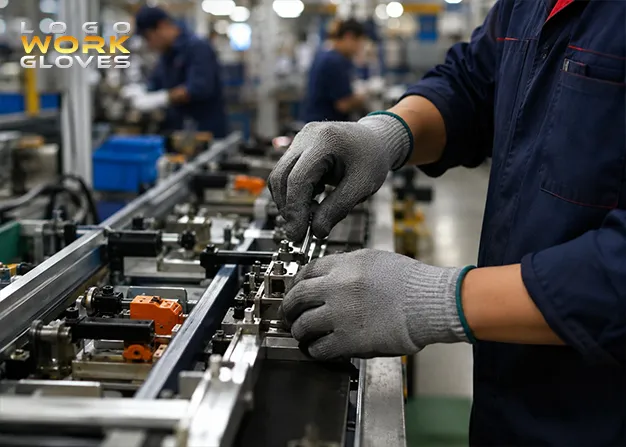
A stamping line loses real production time every time an operator peels off a glove mid shift because sweat has soaked through the fabric or the material is too thick to feel a small fastener anymore. Multiply that across a ten line plant and one wrong glove decision turns into hours of lost output before the week is out.
Choosing hand protection for a production floor is rarely as simple as ordering one case of gloves for the whole plant. A worker torquing bolts on a chassis line needs something different from someone hand loading components onto a circuit board, and both need something different from a material handler moving bins between stations. This guide covers the best gloves for assembly line work, from precision nitrile dips built for fine motor tasks to ANSI rated cut protection for sheet metal handling, so you can match the right glove to the right station instead of guessing.
At Logo Work Gloves, we have outfitted production floors, warehouses, and assembly plants since 1992, and this guide draws on what actually holds up under repetitive, hands on manufacturing work.
Hands do more work than almost any other part of the body on an assembly line, and the injury numbers reflect it. According to the Bureau of Labor Statistics, hand and finger injuries are consistently among the leading causes of days away from work across the manufacturing industry, and contact with machinery remains a top cause of workplace amputations nationwide.
Industry safety associations that track OSHA data report that a large majority of hand and arm injuries are preventable with the right glove, yet a meaningful share of workers either skip gloves or wear the wrong type for the task at hand. That gap is where most manufacturing hand injuries actually happen. It is rarely a lack of gloves. It is the wrong glove for the job.
OSHA addresses this directly. Under 29 CFR 1910.138, employers are required to assess hand hazards on the floor, including cuts, punctures, abrasions, and chemical exposure, then select gloves matched to those specific hazards instead of issuing one generic glove to every station. A one size fits all glove program rarely satisfies that standard, and in practice it usually costs more in re-issued gloves and lost time than a task matched program would.
Common hand hazards on a typical production floor include:
Every glove decision on a production floor comes down to a trade off: dexterity vs protection. A heavier cut resistant glove protects against a stamped metal edge but slows down a worker threading a small connector into place. A thin, high dexterity glove feels natural during fine motor tasks but may not hold up against a sharp burr or a hot component. The best gloves for assembly line work are chosen station by station, not ordered once for the whole plant.
A few factors decide which glove belongs at which station:
Glove change frequency deserves its own mention. If a worker keeps peeling a glove off to regain feel for small parts, that is a sign the station needs a thinner, higher dexterity glove, not a stricter policy about keeping gloves on. Fighting the glove instead of the task is a productivity problem before it is a compliance problem.
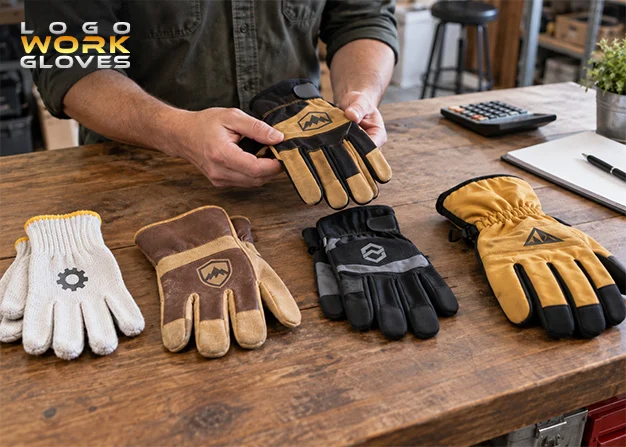
Manufacturing work gloves generally fall into five categories, each suited to a different balance of protection and feel.
| Glove Type | Typical Construction | Best For | Typical ANSI Cut Level | Dexterity |
|---|---|---|---|---|
| Cotton / jersey gloves | Cotton or poly-cotton knit | Light handling, inspection, keeping parts clean | None to A1 | High |
| Nitrile foam dip gloves | 15-gauge nylon or spandex shell with nitrile foam palm | Fastener assembly, small parts, oily components | A1 to A2 | Very high |
| Cut-resistant knit gloves | HPPE or steel-fiber blend with nitrile or polyurethane coating | Sheet metal, stamped parts, sharp edges | A3 to A5+ | High |
| Leather palm gloves | Cowhide or split leather palm with cotton or knit back | Material staging, pallet handling, heavier assembly | A1 to A2 | Moderate |
| Disposable nitrile or PU fingertip gloves | Thin single-use nitrile or polyurethane coating | Electronics assembly, ESD-sensitive tasks | Not rated | Very high |
Nitrile foam palm gloves are the standard choice for stations that need feel more than heavy protection. A typical build uses a 15-gauge nylon or spandex liner with a nitrile foam coating over the palm and fingertips. The foam texture grips small, oily, or slick components without adding bulk, which is why these gloves show up constantly at fastener stations, small parts assembly, and general production work.
Our Custom Dip Gloves use this exact build: a breathable knit back paired with a nitrile foam palm, made for stations where feel matters as much as protection.
For the lightest tasks, plain cotton or jersey knit gloves remain the simplest option. Light duty precision gloves like these keep hands clean, add a thin layer of grip, and let workers feel small components directly through the fabric. They will not stop a sharp edge, but for inspection stations, light packaging, and handling finished parts that need to stay free of fingerprints and oils, cotton is often the right call. Our Custom Cotton Gloves are a common fit for these lower-hazard stations.
Stations that handle stamped metal, trimmed edges, or frequent pinch point injuries from tooling and conveyors call for a cut resistant knit glove. These are built from HPPE or steel fiber blended yarns, usually coated with nitrile or polyurethane on the palm for grip. The right cut level depends on the hazard. Light sheet metal handling often calls for an ANSI/ISEA A3 or A4 rating, while heavier metal fabrication and stamping may call for A5 or higher. We break down how those levels are tested and assigned in our guide to ANSI cut resistant glove ratings and levels, which is worth a read before setting a plant-wide cut level policy.
Our Custom Anti Cut Resistant Gloves can be built to the cut level your hazard assessment calls for, then branded with your company logo for a consistent PPE program across every line.
Not every station is light duty. Material staging, pallet handling, and heavier component assembly benefit from a leather palm glove, which holds up to repeated abrasion and rough surfaces better than knit or cotton alone. A cowhide or split leather palm paired with a cotton or knit back gives workers durability for staging tasks without the stiffness of a full leather glove. Our Custom Leather Palm Gloves are a common choice for teams that move between assembly and material handling during a shift.
Electronics assembly and other ESD-sensitive stations often call for thin disposable nitrile gloves or polyurethane-coated fingertip gloves instead of a reusable work glove. These prioritize dexterity above nearly everything else, since workers are placing small components with tight tolerances and need full tactile feedback. Polyurethane coated fingertip gloves are common here because the coating grips small parts without the thickness of a full nitrile dip.
Assembly line gloves are only useful if they match the actual station. Here is a practical starting point for mapping tasks to glove types before fine-tuning based on your own hazard assessment.
| Task or Station | Primary Hazard | Recommended Glove | Why It Works |
|---|---|---|---|
| Small parts and fastener assembly | Fatigue, dropped or slick parts | Nitrile foam dip, 15-gauge liner | Grips small components without adding bulk |
| Sheet metal or stamped components | Cuts, sharp edges | ANSI A3 to A5 cut-resistant knit | Cut protection without losing feel |
| Electronics or circuit board work | Static discharge, tiny components | ESD-safe disposable nitrile or PU fingertip | High dexterity with anti-static properties |
| Material staging and pallet handling | Abrasion, splinters, rough edges | Leather palm glove | Durable and breathable for heavier handling |
| Tooling changeovers and line resets | Pinch points, oil or grease | Nitrile-coated knit glove | Reliable grip in oily conditions |
| Packaging and final inspection | General handling | Light cotton or knit glove | Breathable comfort for repetitive motion |
Cut level ratings only work as a system when they are applied consistently, which is where ANSI/ISEA and OSHA come in together. OSHA sets the requirement that hand protection must match an identified workplace hazard. ANSI/ISEA 105 provides the testing standard that tells you how much cut, puncture, or abrasion resistance a given glove actually delivers, so the hazard assessment and the glove selection speak the same language.
For a production floor gloves program, that usually means running a station-by-station hazard walk, documenting the cut, puncture, or chemical hazard at each stop, and assigning a glove rated to match. It is worth resisting the temptation to over-protect every station with the highest cut level available. A higher rating is not automatically the safer choice if it costs a worker the dexterity needed to handle small parts accurately, since reduced control can create its own hazard.
Nitrile and polyurethane are the two coatings that show up most often on manufacturing work gloves, and each one is suited to different conditions.
Neither coating is universally better. The right choice depends on whether the station prioritizes grip in wet or oily conditions or maximum dexterity for small, dry components. We cover this comparison in more depth, including how it applies to latex as a third option, in our guide to Nitrile vs Latex Gloves.
Lean manufacturing principles treat unnecessary motion and wasted time as costs worth eliminating, and glove programs are not exempt from that thinking. A glove that a worker has to remove five times an hour to regain dexterity is a source of waste, not a safety feature. The same applies to a glove program with too many SKUs, where supervisors spend time tracking down the right size or style instead of running the line.
A few practical steps help keep a glove program lean without cutting corners on protection:
Many manufacturers now put their logo on the PPE they issue, and gloves are one of the easiest places to do it. A branded glove program gives every operator, from the receiving dock to final assembly, a consistent, professional look, and it makes it easy to tell at a glance whether someone on the floor is wearing company-issued PPE or a personal pair that was never rated for the job.
Logo Work Gloves ships manufacturing and assembly PPE programs to plants across the United States, from Midwest stamping and automotive supply lines to Texas and Southeast production facilities, out of our Colorado facility. Orders start at a 12 dozen minimum, sizes can be mixed within an order, and logos can be applied through debossing, heat transfer, or embroidery depending on the glove style.
Whether you are outfitting a single line or every shift across the plant, the best gloves for assembly line work balance protection with the dexterity your team needs to keep production moving, and a consistent, branded program makes it easier to manage that balance across every station.
Ready to build a glove program for your floor? Request a free proof or call 888-804-2925 to talk through your stations with our team.
For small parts and fastener assembly, a nitrile foam dip glove with a 15-gauge liner is usually the best fit. The foam palm grips small or slightly oily components without adding the bulk that slows down fine motor tasks.
Not at every station. Cut-resistant gloves are necessary where workers handle stamped metal, trimmed edges, or other sharp materials, but stations that only involve soft or finished components are often better served by a lighter cotton or nitrile foam glove that preserves dexterity.
Replacement schedules depend on the material and the task, but a good signal is glove change frequency itself. If gloves are showing wear, losing grip, or being removed constantly to complete tasks, that station likely needs a different glove type, not just a faster replacement cycle.
Nitrile holds up better against oils, grease, and abrasion, making it common for general assembly and metal handling. Polyurethane coatings are thinner and offer more tactile feedback, which is why they are more common on precision and electronics assembly tasks.
Yes. Cotton, nitrile dip, cut-resistant, and leather palm gloves can all be produced with a company logo through debossing, heat transfer, or embroidery, which is a common way manufacturers standardize PPE and reinforce brand identity across the floor.

Thank You