Choosing the right gloves is essential for safety, performance, and long-term efficiency in any work environment. One of the most common comparisons businesses make is nitrile vs latex gloves, especially when selecting protective gear for teams in construction, automotive, industrial, or general work settings.
Both glove types offer unique advantages, but the right choice depends on your specific use case, work conditions, and safety requirements. Understanding the differences between nitrile vs latex gloves can help you make a smarter investment especially when considering durability, comfort, and branding opportunities.
Nitrile gloves are more durable, chemical-resistant, and suitable for people with latex allergies, while latex gloves offer better flexibility and comfort. For most industrial and work environments, nitrile gloves are the preferred choice.
If you’re wondering what is nitrile glove, it is a synthetic rubber material designed to provide strong resistance against chemicals, oils, and punctures.
Many businesses prefer nitrile because:
This also answers common questions like:
Nitrile gloves are completely non-latex gloves, making them safe for workers with latex allergies.
Nitrile gloves are widely used in:
Products like nitrile dipped gloves and nitrile coated gloves are especially popular for heavy-duty work due to their grip and durability.
Latex gloves are made from natural rubber. They are known for:
This makes them suitable for tasks requiring precision.
Latex work gloves are commonly used in:
However, they come with limitations, especially in environments involving chemicals or oils.
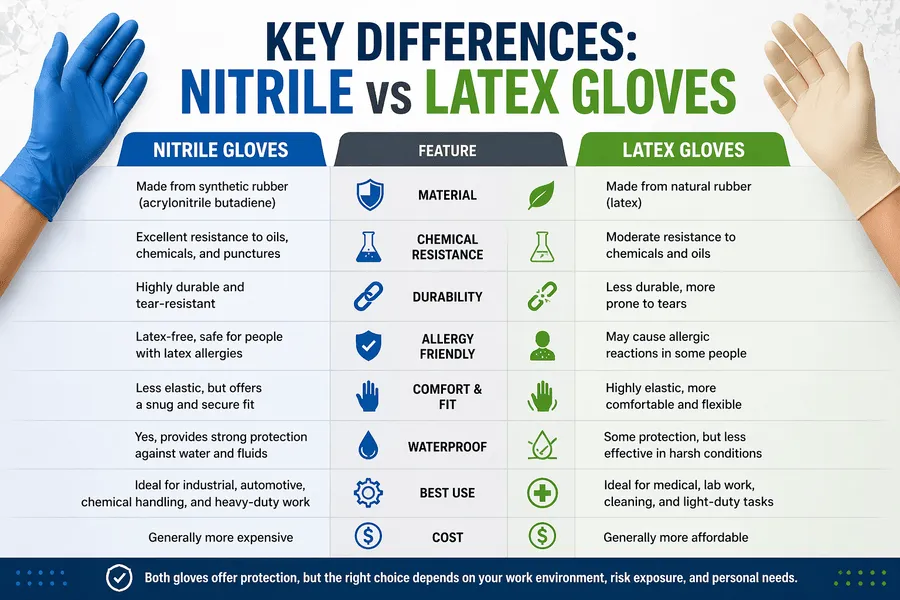
Nitrile gloves are more resistant to:
Latex gloves, while flexible, are more prone to damage under heavy use.
Nitrile performs significantly better when exposed to:
This is why they are often preferred as rubber gloves for oil handling and industrial tasks.
Latex gloves provide:
However, nitrile gloves have improved significantly and now offer a balance between comfort and durability.
One major concern is latex allergies. Many workers are sensitive to natural rubber, making nitrile the safer option.
This answers common queries like:
Nitrile gloves are completely latex-free.
Another option in the market is polyurethane gloves or PU coated gloves. These gloves are:
However, they are not as durable as nitrile for heavy-duty tasks.
Many users ask, are nitrile gloves waterproof?
Yes, nitrile gloves provide strong resistance to liquids, making them suitable for:
Latex gloves also offer some water resistance but are less reliable in harsh conditions.
For most businesses, especially in industrial and commercial sectors, nitrile gloves provide the best balance of:
They are ideal for companies that require consistent performance across demanding environments.
Beyond material choice, businesses are increasingly investing in customized gloves for branding and professionalism. Custom gloves:
Companies looking to combine performance with branding often choose providers like Logo Work Gloves, where durability meets customized design.
When selecting between nitrile vs latex gloves, consider:
For example:
The choice between nitrile vs latex gloves ultimately depends on your work requirements. While latex gloves offer comfort and flexibility, nitrile gloves stand out for their durability, chemical resistance, and safety.
For most industrial and business applications, nitrile gloves are the more reliable and versatile option. When combined with custom branding, they not only protect your workforce but also strengthen your company’s professional image.
Nitrile gloves are synthetic and more durable, while latex gloves are natural rubber and more flexible.
For industrial use, nitrile gloves are generally better due to durability and chemical resistance.
No, nitrile gloves are completely latex-free and safe for people with allergies.
Nitrile gloves are the best option for handling oils and chemicals.
Yes, latex gloves are still used for light tasks requiring flexibility and comfort.