
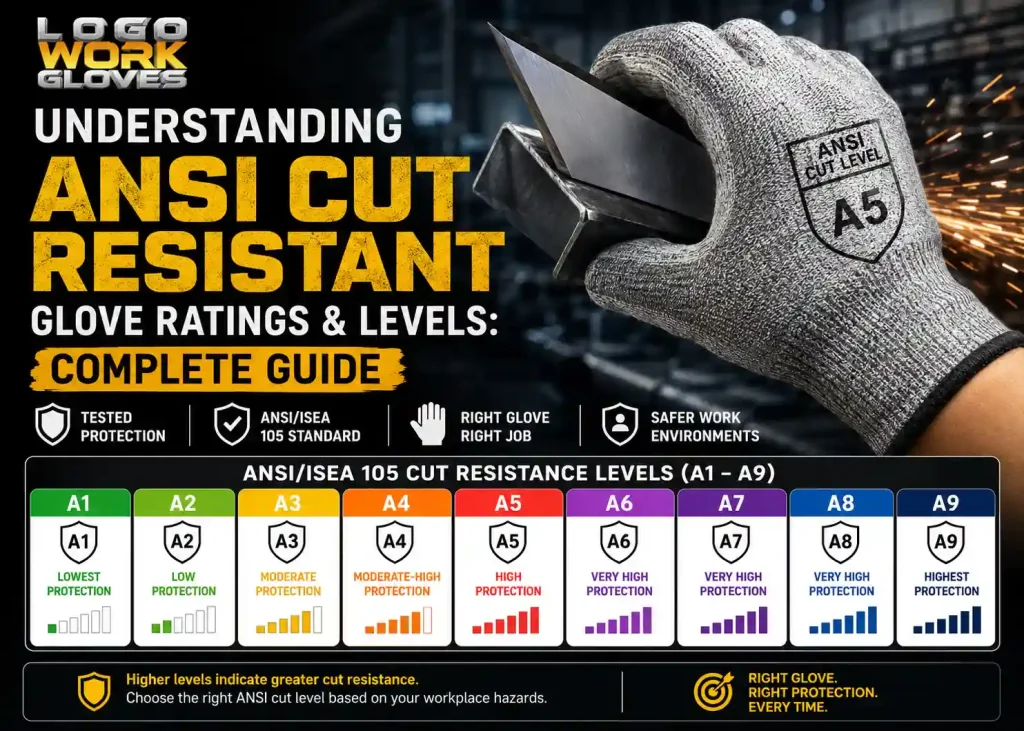
When selecting safety gloves for construction, warehousing, manufacturing, automotive work, or material handling, understanding ansi cut resistant glove ratings is essential. Not all cut-resistant gloves offer the same level of protection, and choosing the wrong glove can expose workers to unnecessary risks.
Many employers purchase gloves based on price or appearance without understanding how glove protection is measured. However, workplace injuries involving sharp materials, metal edges, glass, sheet metal, and cutting tools can often be reduced by selecting gloves with the appropriate cut resistance level.
This guide explains ansi cut resistant glove ratings, how the ANSI/ISEA 105 standard works, what each cut level means, and how businesses can choose the correct gloves for different work environments.
ANSI cut resistant glove ratings are a standardized method used to measure how much force a glove can withstand before being cut by a sharp blade.
The rating system is governed by the ANSI/ISEA 105 standard, which helps employers, safety managers, and workers compare gloves using a consistent measurement system.
Instead of guessing whether one glove provides better protection than another, ANSI ratings establish clear performance levels that make glove selection easier and more reliable.
Understanding these ratings is important because different jobs require different levels of cut protection.
The ANSI/ISEA 105 standard is the primary North American benchmark used to classify hand protection performance.
ANSI stands for the American National Standards Institute, while ISEA refers to the International Safety Equipment Association.
The standard evaluates several glove performance categories, including:
For most industrial environments, cut resistance remains one of the most important performance measurements.
The latest versions of ANSI/ISEA 105 gloves use laboratory testing methods that provide accurate and repeatable cut resistance data.
Workers across many industries regularly encounter sharp hazards, including:
Without adequate protection, hand injuries can lead to:
Understanding ansi cut ratings helps employers match glove protection to workplace hazards.
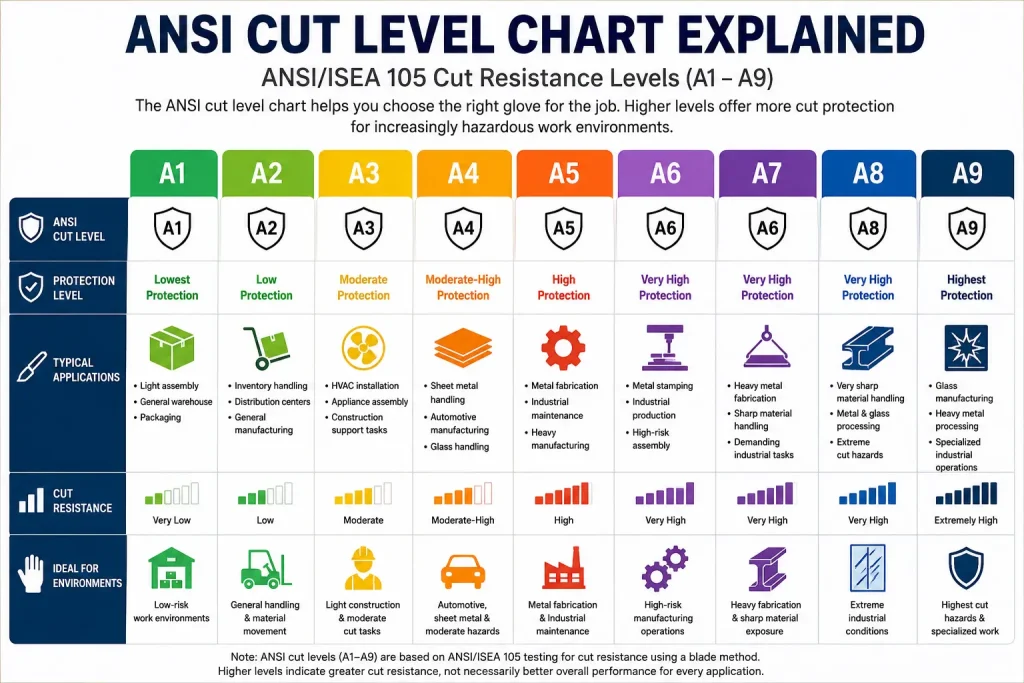
One of the most searched topics related to glove safety is the ansi cut level chart.
The ANSI system uses levels ranging from A1 through A9.
A1 gloves provide the lowest level of cut protection.
Typically used for:
ANSI A2 gloves offer increased protection while maintaining flexibility.
Common applications include:
ANSI A3 cut resistant gloves are commonly used where workers encounter moderate cut hazards. you can grab your perfect pair of custom anti cut resistant gloves with your company logo printed on from LogoWorkGloves.
Examples include:
ANSI A4 protection is often recommended for:
Many safety professionals consider A4 one of the most versatile cut resistance levels available.
ANSI cut level 5 gloves are designed for environments with significant cut hazards.
Applications include:
A6 cut resistant gloves provide advanced protection against sharp materials.
Often used in:
These levels are designed for very demanding industrial applications where exposure to sharp materials is frequent.
ANSI A9 represents the highest cut resistance level currently available.
Used for:
Many people compare the ansi glove rating chart with European EN388 standards.
Both systems evaluate cut resistance, but they use different testing methods and classifications.
ANSI ratings are most commonly used in North America, while EN388 ratings are widely used throughout Europe.
Although both systems measure glove protection, employers should avoid directly comparing one rating system to another without understanding the testing methodology.
For businesses operating in the United States and Canada, ansi glove ratings are typically the preferred standard.
The purpose of ansi cut resistance levels is to help businesses select gloves based on actual workplace risks.
Higher ratings do not automatically mean better gloves.
Instead, the correct glove depends on:
A warehouse employee handling cardboard boxes may require a different cut level than a worker handling sheet metal.
Choosing the proper glove starts with a hazard assessment.
Recommended levels:
Common environments:
Recommended levels:
Common environments:
Recommended levels:
Common environments:
Cut protection is only one aspect of workplace hand safety.
Many industries also use ansi impact rating gloves to reduce injuries caused by:
Impact protection and cut resistance are separate ratings.
A glove may offer excellent cut protection while providing little impact resistance.
Workers should evaluate both ratings when selecting PPE.
Beyond cut resistance, ANSI standards also evaluate:
ANSI puncture levels help measure a glove’s ability to resist penetration from sharp objects.
This is particularly important for:
Abrasion testing evaluates how well gloves withstand repeated wear.
Higher abrasion resistance generally leads to:
Some gloves are designed for environments involving elevated temperatures.
Heat ratings help determine whether gloves are suitable for welding, fabrication, or industrial processes.
Many workers misunderstand what cut-resistant gloves actually do.
Even the highest-rated gloves can be cut under certain conditions.
The purpose of cut-resistant gloves is to reduce injury risk, not eliminate it entirely.
Using an A9 glove for a low-risk warehouse task may reduce dexterity and productivity unnecessarily.
Selecting the appropriate protection level is more important than choosing the highest rating available.
Employers should also evaluate:
Many industries rely on ansi cut resistant gloves as part of their PPE programs.
Common examples include:
Each industry may require different levels of protection based on workplace hazards.
Many companies now invest in custom-branded PPE to improve professionalism and workforce consistency.
Custom cut-resistant gloves help businesses:
Organizations looking for durable, branded hand protection often work with Logo Work Gloves to combine ANSI-rated safety gloves with custom logo printing for construction, warehouse, manufacturing, and industrial teams.
Understanding ansi cut resistant glove ratings is essential for selecting the right hand protection for workplace hazards. The ANSI/ISEA 105 standard provides a reliable way to compare gloves and determine appropriate cut protection levels for different industries and job tasks.
Whether workers require A2 gloves for warehouse operations, A4 gloves for construction work, or A6 protection for industrial applications, choosing the correct ANSI cut level helps improve safety, reduce injuries, and support compliance programs.
The best glove is not necessarily the highest-rated glove. It is the glove that provides the right balance of protection, comfort, durability, and performance for the specific task being performed.
ANSI cut resistant glove ratings measure how much force a glove can withstand before being cut by a sharp blade under standardized testing conditions.
ANSI A9 is currently the highest cut resistance level available under the ANSI/ISEA 105 standard.
ANSI A4 gloves provide moderate-to-high cut protection and are commonly used in construction, manufacturing, and sheet metal handling.
No. ANSI and EN388 use different testing methods and rating systems, although both measure cut resistance performance.
The correct ANSI cut level depends on the hazards present in the workplace, the materials being handled, and the level of protection required.