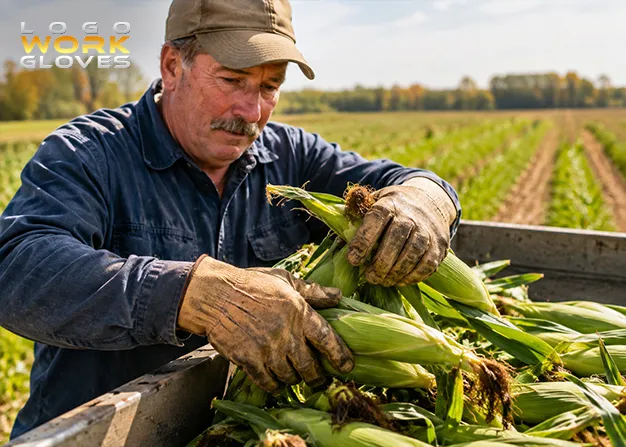

Harvest starts and the glove box empties in nine days. A seasonal crew of fourteen shows up, half of them get the wrong size, three pairs are soaked through by noon on day one, and by the second week most of the crew is running bare-handed through baling twine and thistle.
The best work gloves for farming are not one glove. They are a small, deliberate kit: a heavyweight cowhide double palm for baling and fencing, a coated latex or nitrile palm for wet produce and livestock work, and a soft driver style for equipment and long tractor days. Match the glove to the task, stock three sizes, and issue enough pairs that nobody works in a wet one.
Logo Work Gloves LLC has been supplying branded hand protection to American operations since 1992, and we ship to farms, ranches and packing sheds from our home base in Monument, Colorado out to the Central Valley, the Corn Belt and the Southeast. This guide covers what actually holds up through a harvest season, and how to buy it for a crew instead of a single pair.
Agriculture concentrates hand injuries because farm work puts unprotected hands directly against blades, wire, hydraulics, animals and chemicals dozens of times per shift, which means the hand is the body part most often in the hazard zone.
The numbers back that up. The American Academy of Orthopaedic Surgeons figures widely cited across the safety industry place hand injuries at somewhere between 40 and 70 percent of all farm injury admissions. Bureau of Labor Statistics data reported by OSHA has put agriculture’s fatality rate at 22.2 per 100,000 full-time workers, the highest of any industry sector, and nonfatal injuries in the tens of thousands per year.
Then there is the glove-specific layer. Safety industry data compiled from BLS, OSHA and National Safety Council sources indicates that roughly 70 percent of hand injuries happen to workers wearing no hand protection at all, and about 30 percent happen to workers wearing the wrong glove for the job. Read that carefully. Both failure modes are purchasing decisions, not accidents.
OSHA also lists repetitive, forceful and prolonged hand exertions among the recognised ergonomic risk factors in agricultural operations. A glove that is stiff, oversized or soaked forces a worker to squeeze harder to hold the same tool, which feeds straight into that risk factor. Fit is a fatigue control, not a comfort preference.
Task hazard drives glove selection on a farm because a single operation spans wire, blades, animals, chemicals and dust in one day, and no single construction handles all five well.
| Farm task | Primary hazard | Recommended construction | Logo Work Gloves option |
|---|---|---|---|
| Hay baling, twine, stacking | Abrasion, friction burn, splinters | Cowhide double palm, safety cuff | Green Cowhide Double Palm, $7.34 |
| Barbed wire and fence repair | Puncture, laceration | Cut-resistant sewn palm, reinforced thumb | Cowhide Kevlar Sewn, $9.13 |
| Blade work, silage knives, augers | Cut and puncture | Kevlar-reinforced double palm | Cowhide Double Palm Kevlar, $13.02 |
| Wet produce, washdown, livestock | Wet grip loss, moisture | Heavyweight latex coated palm | Orange Latex Heavyweight, $9.33 |
| Hand harvest, sorting, packing line | Dexterity, minor abrasion | Lightweight coated palm, knit shell | Nitrile Foam |
| Equipment operation, tractor, hauling | Vibration, blisters, long wear | Soft leather driver, unlined | Pigskin Driver, Deerskin Driver |
| Roadside hauling, night silage, traffic | Low visibility | Hi-vis shell or hi-vis leather | High Visibility Yellow Double Palm, $10.57 |
| Cold-weather chores, winter feeding | Cold, wet, wind | Lined leather palm | Cowhide Lined, Elkskin Driver Heavyweight |
Our full custom agricultural gloves range is built around exactly this spread, so a single order can cover the whole operation instead of forcing one compromise glove across every job.
The best hay baling gloves use a cowhide double palm with a safety cuff. Baling generates constant friction from twine and stem abrasion, and a second layer of leather across the palm and thumb crotch doubles the wear surface where bales actually rub. The safety cuff keeps chaff out and releases fast if a hand gets caught.
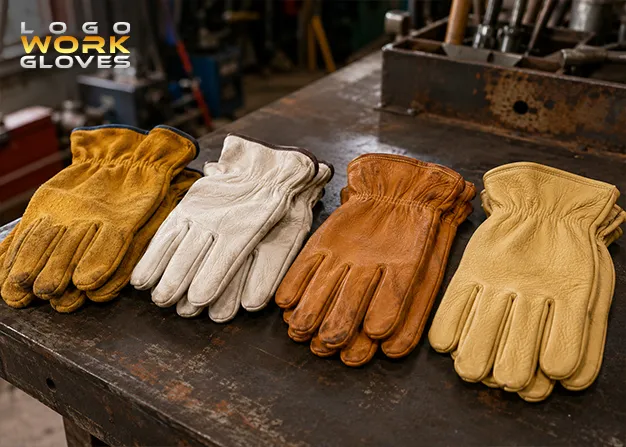
Hide type determines how a farm glove ages, because each leather trades abrasion resistance against suppleness and moisture behaviour differently, and farm work punishes all three properties in the same week.
| Leather | Abrasion resistance | Dexterity | Wet performance | Best farm use |
|---|---|---|---|---|
| Cowhide | Highest | Moderate | Stiffens when dried hard | Baling, fencing, loading, general field work |
| Pigskin | High | Good | Stays soft after wetting | Wet chores, washdown, all-round ranch work |
| Goatskin | High for its weight | Excellent | Good, natural lanolin | Fine harvest work, irrigation, repair tasks |
| Deerskin | Moderate | Highest | Softens, needs care | Equipment operation, long tractor and truck days |
| Elkskin | High | Good | Very good, resists hardening | Cold and wet feeding chores, winter ranch work |
Pigskin deserves more attention than it gets on farms. Pigskin’s fibre structure lets moisture pass and it dries soft instead of going board-stiff, which matters when a glove gets soaked in the morning and has to be worn again after lunch. Our pigskin driver style is a common pick for mixed livestock and equipment work for that reason.
Deerskin is the opposite trade. Deerskin gives the closest thing to bare-hand feel in a leather glove, which suits long days on a tractor seat or handling small hardware, but deerskin will not survive a week of fence pulling. Compare the full range on our leather gloves custom page, and if you want the deeper breakdown of hide behaviour, our guide to types of leather for work gloves covers it hide by hide.
Barbed wire handling requires puncture resistance rather than cut resistance, because a barb concentrates force on a single point and slides between yarns instead of slicing across them, which is a different failure mode than a blade.
This distinction gets missed constantly. A high cut-rating knit glove can still let a barb through. What stops a barb is material density and layered leather: a sewn Kevlar palm, a double palm, or a reinforced thumb and index finger where the wire is actually gripped.
In practice, fencing crews do best with the cowhide kevlar sewn construction. The Kevlar thread survives the abrasion that destroys ordinary cotton stitching first, which is where most fencing gloves fail long before the leather itself gives out. If your operation also runs blade and silage work, our custom anti cut resistant gloves page covers rated options, and our explainer on ANSI cut resistant glove ratings shows what each level actually means before you pay for a level you do not need.
One practical habit worth building: issue fencing gloves as a dedicated pair, not the same pair used for produce handling. Wire embeds fine metal fragments in leather, and those fragments transfer to whatever the hand touches next.
Livestock handling gloves fail on grip rather than durability, because a wet hide, a wet rope and a wet glove together produce a friction coefficient low enough that the worker’s hand slips before the animal does.
Dry leather grips a dry hide well. Add rain, sweat, milk, manure or wash water and untreated leather turns slick. That is the moment a lead rope runs through a palm and takes skin with it.
Two constructions solve it. A crinkle or textured latex coating displaces liquid at the contact surface, which is why heavyweight latex palms dominate dairy parlours, sorting alleys and washdown work. Our orange latex heavyweight style is built for that specific job. For lighter handling and sorting where feel matters more, custom dip gloves in a foam nitrile palm keep grip on damp surfaces without the bulk.
The second option is a double palm leather for rope and chute work where abrasion outranks moisture. The extra leather layer takes the rope burn.
A note from real-world use on cattle operations: workers handling animals often size down deliberately. A loose glove that rotates on the hand during a pull is worse than no glove, because the leather moves and the skin underneath does not.
Chemical and fertiliser contact requires a different glove category entirely, because leather absorbs liquid chemicals and holds them against skin, which turns a protective glove into a prolonged exposure device.
State this plainly to your crew: leather is not chemical protection. For mixing, loading and spraying pesticides, herbicides or liquid fertiliser, use unlined chemical-resistant gloves selected against the product label, and follow the label’s specified glove material. Then remove and wash them before touching anything else.
Grain dust brings a separate issue. Grain dust is abrasive and it works into glove seams, and dust-laden gloves rubbed against eyes or face carry that irritant with them. For grain handling, bin sweeping and auger work, a smooth-finish coated palm sheds dust better than a napped leather. Our nitrile foam and nitrile smooth options wash off in seconds where leather has to be beaten out.
Cotton gloves have a real role here too, as a cheap, high-rotation option for dusty sorting and handling where you replace rather than clean. Our custom cotton gloves and cotton riggers canvas styles cover that use, though cotton absorbs sweat rather than moving it, so plan on more pairs per worker.
Glove liner sweat drives non-compliance because trapped moisture softens skin, degrades grip and causes blisters, which means a hot glove gets removed and the removed glove protects nobody.
This is the single most underrated variable in agricultural gloves. The most protective glove in the shop provides zero protection sitting on the fender of a tractor.
Three fixes that work in the field:
Our guide to work gloves for hot weather goes deeper on breathability and liner construction, and much of it applies directly to July harvest work.
Seasonal labour creates a PPE tracking problem that permanent-crew operations never face, because gloves issued to short-term workers walk off, get swapped, and vanish without any record of who had what.
Here is the pattern almost every operation recognises. You buy a case of gloves in August. By the second week of September, half are gone and nobody can say where. So the next order is cheaper gloves, which fail faster, which means more removal, which means more bare hands.
Three controls fix most of it:
If you are unclear on who carries the cost of all this, our article on who is responsible for buying PPE covers employer obligations in plain terms.
Correct sizing improves protection because a glove that shifts on the hand transfers grip force into friction, which produces blisters, and blistered workers stop wearing gloves entirely.
Measure around the dominant hand at the widest point across the knuckles, excluding the thumb. That measurement in inches is the glove size. A worker measuring 9 inches wears a size 9, which is a large in most sizing charts.
For mixed crews, stock small through extra large rather than ordering everything in large. Roughly speaking, most harvest crews we supply need a spread across at least three sizes, and women on the crew are the group most often left with gloves that do not fit. We let customers mix sizes and styles within a single order specifically so operations do not have to guess and over-buy.
The fit test that matters: make a full fist. If the leather bunches painfully across the knuckles, size up. If you can pinch loose material at the fingertip, size down.
Glove economics on a farm are driven by wear rate rather than sticker price, because a cheap glove replaced four times in a season costs more than a good glove replaced once and protects worse in between.
Run the arithmetic for a fourteen-person harvest crew across a ten-week season:
The cheap option costs more and delivers less protection at every point in the cycle. Add one avoided hand laceration, which carries direct medical and lost-time cost well into the thousands, and the comparison stops being close.
Volume pricing helps further. Our initial orders start at 12 dozen mixed across sizes and styles, with a one-time $95 setup fee per logo. After that we keep your artwork on file, so reorders can be as small as a couple of dozen with no additional setup charge.
Choosing farm gloves works as a sequence, because starting from comfort produces a glove that fails the hazard, and starting from maximum protection produces a glove nobody keeps on.
Write down every job that puts hands at risk: baling, fencing, blade work, livestock, chemical handling, grain, equipment. This becomes your glove kit list.
Use the task table above. Most operations land on two or three constructions covering roughly 90 percent of the work, plus a dedicated chemical glove kept separate.
Dry and abrasive means cowhide double palm. Wet and slick means coated latex or nitrile. Long-wear and dexterous means pigskin, goatskin or deerskin driver.
Measure at intake, stock at least three sizes, and record sizes for reordering.
Two or three pairs per worker in peak heat, one dedicated fencing pair, and a clear replacement trigger.
Order samples in the shoulder season, put them on the crew doing real work for a week, and ask one question: did you keep them on? We ship free samples the same day so this test can happen before you commit to volume.
Custom branding works on agricultural gloves because leather and coated shells both accept durable logo application, which turns required PPE into visible identity and traceable inventory at no cost to performance.
Debossing presses a heated plate into full-grain leather for a crisp permanent indent that does not stiffen the hide. Heat transfer applies a full-colour graphic to the back of the glove. Direct printing suits knit and coated shells.
For farm operations running roadside hauling, custom orders and agritourism, branded gloves also do quiet marketing work. Every hand at the farmers market, the co-op and the equipment dealer carries your name. Request a free proof and you will see your logo on the actual glove before anything goes to production.
The best gloves for harvest crews pair a lightweight coated palm for hand picking and sorting with a cowhide double palm for loading and bale handling. Stock at least three sizes, issue two pairs per worker during peak heat, and brand them so gloves stay with your operation through the season.
No. Leather absorbs liquid chemicals and holds them against skin, extending exposure rather than preventing it. Use unlined chemical-resistant gloves selected against the specific product label for all mixing, loading and spraying, remove them before touching anything else, and never substitute leather or coated work gloves.
Replace farm gloves on condition rather than schedule. Swap any glove with a torn palm, exposed seam, stiffened leather, or persistent saturation. Under heavy harvest use, most crews go through two to three pairs per worker per season, and fencing gloves usually wear out first.
Heavyweight latex or textured nitrile palm coatings work best for wet livestock handling, because the textured surface displaces liquid and maintains friction where wet leather turns slick. Size snugly so the glove cannot rotate on the hand during a pull, and keep livestock gloves separate from produce handling gloves.
Yes. Logo Work Gloves LLC supplies branded agricultural gloves nationwide, with initial orders starting at 12 dozen mixed across sizes and styles and a one-time $95 setup fee per logo. Artwork stays on file afterward, so reorders can be as small as a couple of dozen with no additional setup charge.
The best work gloves for farming are the ones still on your crew’s hands in week eight of harvest. Given that roughly 70 percent of hand injuries happen to workers wearing nothing at all, and another 30 percent to workers wearing the wrong glove, the two decisions that matter most are stocking the right construction for each task and issuing enough pairs that nobody works in a wet one.
Build a small kit instead of chasing one universal glove. Double palm cowhide for baling and fencing, coated latex or nitrile for wet and livestock work, a soft driver for equipment days, and a separate chemical glove kept well away from the rest. Size for the actual crew, brand the gloves so they stay put, and trial the finalists before the season rather than during it.
Logo Work Gloves LLC has supplied American operations with branded hand protection since 1992, shipping nationwide from Monument, Colorado. Browse the full product range, read more about our team, or contact us at 888-804-2925 and we will get harvest samples out the same day.